Insurance District Retail Space for Rent
Expert Tenant Broker
We represent you, not the landlord
 Direct
 Sublease
 coworking
Insurance District Retail Space Listings
| Class | Address | SF | Monthly Rent |
|---|---|---|---|
| B | Nassau St & Ann Street Ground floor (full) | 11,800 | $ Negotiable |
| B | William St & Beekman Street Floor 1 (full) | 10,800 | $ Negotiable |
| A | Park Row & Beekman Street Floor 4 (full) | 9,600 | $ Negotiable |
| C | Beekman St & Nassau Street Floor 1 (full) | 4,000 | $ 30,200 |
| A | Park Row & Ann Street Ground floor | 3,500 | $ Negotiable |
| A | Maiden Lane & Pearl Street Ground floor | 2,500 | $ 31,200 |
| A | Maiden Lane & Pearl Street Ground floor | 2,300 | $ 27,600 |
| B | Maiden Lane & William Street Ground floor | 1,800 | $ Negotiable |
| B | Hanover Sq & Pearl Street Ground floor | 1,500 | $ 16,400 |
| B | Broadway & Maiden Lane Ground floor | 1,500 | $ Negotiable |
| A | Maiden Lane & Pearl Street Ground floor | 1,200 | $ 16,600 |
| A | Maiden Lane & Nassau Street Ground floor | 1,100 | $ Negotiable |
| Class | Address | SF | Monthly Rent |
|---|---|---|---|
| A | Maiden Lane & Pearl Street Ground floor | 5,400 | $ Negotiable |
| A | Fulton St & Cliff Street Mezzanine | 3,600 | $ Negotiable |
| A | Water St & Gold Street Floor 1 | 1,900 | $ Negotiable |
| Class | Address | SF | Monthly Rent |
|---|---|---|---|
| B | Franklin St & Greenwich Street Tribeca · Lower level (full) | 4,800 | $ 20,000 |
| B | Franklin St & Greenwich Street Tribeca · Floor 2 (full) | 4,600 | $ 19,200 |
| C | Duane St & Broadway City Hall · Ground floor | 2,100 | $ Negotiable |
| A | Broadway & Grand Street SoHo · Lower level | 2,000 | $ Negotiable |
| B | Fulton St & Front Street Insurance District · Floor 1 | 2,000 | $ 20,800 |
| B | Fulton St & Front Street Insurance District · Floor 1 | 2,000 | $ 20,800 |
| C | Chambers St & West Broadway Tribeca · Floor 1 | 2,000 | $ Negotiable |
| C | Howard St & Mercer Street SoHo · Floor 1 | 2,000 | $ 58,200 |
| B | E 8th Street & Broadway Greenwich Village · Ground floor | 1,300 | $ Negotiable |
| B | E 8th Street & Broadway Greenwich Village · Ground floor | 1,300 | $ 18,800 |
| A | Chambers St & Church Street Tribeca · Ground floor | 1,100 | $ Negotiable |
Retail Tenants Rented / Leased Insurance District
- Chickpea leased 2,582 SF at 110 William St
- FedEx/Kinko's leased 4,000 SF at 110 William St
- Manhattan Plant Exchange leased 1,400 SF at 277 Water St
- Rainbow Apparel leased 5,714 SF at 40 Fulton St
- Duane Reade leased 5,365 SF at 222 Broadway
- Modell's Sporting Goods leased 10,000 SF at 150 Broadway
- Sephora leased 6,700 SF at 150 Broadway
- Gold's Gym leased 23,797 SF at 90 John St
Why Optimal Spaces Tenant Broker
- Lease negotiation: full terms, renewals, expansion options
- Cost analysis, inventory identification, negotiating scope
- Risk mitigation against hidden pitfalls
Cost Savings
- Negotiate 30+ leasing points to prevent hidden costs
- Save 10–15% on total leasing costs
- Save 100–200 hours filtering unviable spaces
- Property access via broker databases and networks (off-market, subleases, future availability)
Alone or With Other Brokers
- Managing agents owe a fiduciary duty to landlords, seeking maximum price and terms rather than tenant savings.
- Inherent conflict of interest as most brokers represent landlords
- Risk of weaker terms and overlooked hidden costs
- Heavy workload falls on you while best spaces are missed
About Insurance District
Geographic Boundaries
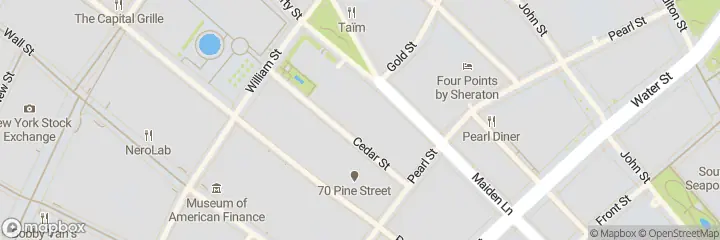
The "Insurance District" in NYC is not an officially designated neighborhood but likely refers to areas historically tied to insurance companies, often overlapping with parts of Lower Manhattan. While no formal boundaries exist, the Financial District (home to major insurers) serves as a proxy. Key landmarks include the area south of Chambers Street, bordered by the Hudson River to the west, the East River to the east, and near City Hall to the north. Nearby community districts, such as CB2 (Greenwich Village, SoHo) to the north and CB1 (Financial District) to the south, share adjacent commercial zones.
Businesses and Commercial Profile
The neighborhood hosts corporate headquarters, boutique financial firms, and specialized insurance brokers. Ground-floor retail includes luxury watch stores, high-end suit retailers, and fine dining establishments. Notable restaurants range from Michelin-starred steakhouses to century-old oyster bars catering to professionals. Jewelry wholesalers and tech-forward office supply stores cluster near Broadway, while artisanal coffee shops occupy historic buildings.
Historical Attractions
Following the Great Fire of 1835, this area became a hub for marine insurers protecting shipping enterprises. The Equitable Building at 120 Broadway (1915), built for the Equitable Life Assurance Society, is now a landmarked office building. By the 1960s, skyscraper construction attracted global reinsurance firms, with many occupying mid-century modernist towers. The Federal Reserve Bank of New York and the Alexander Hamilton U.S. Custom House anchor the district’s financial legacy.
Architectural Landscape
Pre-war Art Deco skyscrapers dominate, featuring limestone facades and bronze entryways. Post-9/11 construction introduced LEED-certified glass towers with suspended gardens. Adaptive reuse projects have converted 1920s bank buildings into coworking spaces, preserving vault doors as decorative elements. Below-ground concourses link buildings through a climate-controlled network of retail arcades.
Transportation Infrastructure
The neighborhood is served by subway lines converging at Fulton Street Station, including the 2/3, 4/5, A/C, J/Z, and R/W trains. Ferry terminals at Pier 11 provide routes to Brooklyn and New Jersey. Bike lanes along Water Street connect to the East River Greenway. Helicopter charters operate from Downtown Manhattan Heliport for executive travel.
Adjacent ZIP Codes
Primary ZIPs include 10005, 10007 (City Hall area), and 10038 (South Street Seaport). Adjacent codes: 10002 (Chinatown), 10012 (SoHo), and 10004 (Battery Park). These reflect transitions from financial cores to mixed-use residential zones.
Corporate Presence
Businesses here include actuarial consultancies, forensic accounting firms, and legal practices specializing in maritime insurance law.
Landmark Structures
The 1903 New York Stock Exchange Building, though not strictly an insurer, symbolizes financial interdependence. The 1932 70 Pine Street (formerly AIG headquarters) features a pyramidal crown visible across the harbor.
Regulatory Environment
Proximity to the New York State Department of Financial Services enables rapid compliance. Air rights transfers from landmarked buildings fund modernization of adjacent properties.
Cultural Institutions
Fraunces Tavern, where Washington bid farewell to his officers, is now a museum and restaurant.
✔ We represent only Tenants.
✔ We bid landlords against each other to save you 10-15%.
✔ Weed out bad spaces saving you 100-200 hours.


